Privacy Settings
In order to be able to better respond to the interests of our customers and talents, this site uses third-party website Tracking technologies.
Since March 2024, the “recognition partnership” has been in place. Its introduction was part of the reform of Germany’s Skilled Immigration Act. It allows international skilled professionals from third countries (i.e. from outside the EU) to enter Germany without having completed the full recognition process for their professional qualification in advance. In practical terms, this means that international skilled professionals can already start working in Germany and, at the same time, begin their recognition process with the support of their employer.
This requires a binding agreement between the employer and the international skilled professional. In this agreement, the employer undertakes to apply jointly with the skilled professional for recognition of the professional qualification in Germany and to actively support the process. Ideally, the employer should therefore already have some experience in recruiting skilled professionals. This is where service providers such as TalentOrange come in: before the recognition partnership is concluded, professional recruiters assess whether the qualifications are eligible for recognition in Germany. TalentOrange now uses this instrument for 80 percent of the skilled professionals entering the country – both for nurses and other healthcare professions as well as for early childhood educators. The service provider makes the relevant know-how available to the employer and supports them throughout the process.
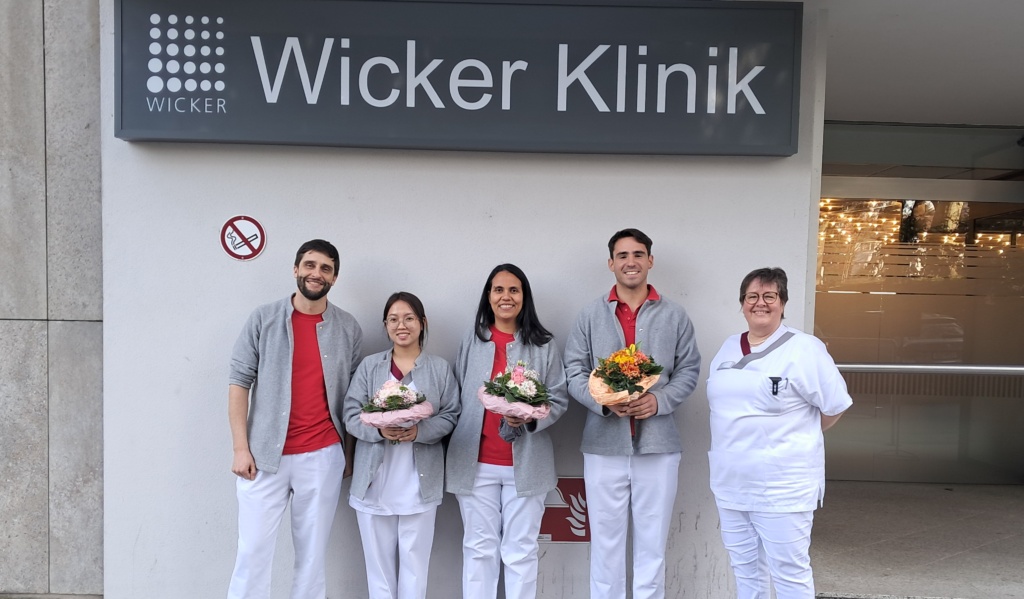
“We have now been using the recognition partnership for almost two years and have had very positive experiences all round,” says Martina Schlögl, Director of Nursing Services at Wicker Klinik / Wirbelsäulenklinik in Bad Homburg. In 2025, Wicker Klinik recruited nurses from Vietnam, Brazil, and Namibia, as well as physiotherapists from Colombia and Chile. In 2026, the arrival of additional nurses from India and Myanmar is planned. “These are state-recognized qualifications from countries that are known for providing good training. We always had the Defizitbescheid in time before registering for the Kenntnisprüfung – and under the new model, that is the first point at which we actually need it.” The entry process is shortened by two to five months through the recognition partnership.
This experience is also confirmed by Vera Surkow, Advisor to the Nursing Directorate at Kreiskliniken Reutlingen, and Julia Schmid, HR Manager at the hospital group. They have been using the recognition partnership since mid-2025; so far, 57 nurses have entered Germany under this model. Compared with the previous model, the hospital has experienced an acceleration of the process of around two months per skilled professional. “The Defizitbescheid was always available in time before registration for the Kenntnisprüfung. There was never any critical situation,” confirm Vera Surkow and Julia Schmid. For 2026, the recruitment of 48 nurses from abroad is planned. Kreiskliniken Reutlingen conducts the preparation course for the Kenntnisprüfung at its own academy. It comprises six course weeks spread over six months – that is, one course week per month. Before that, the talents work for two to three months on their respective wards, allowing them to settle in and “acclimatize.” This applies in every respect: the nurses from abroad get used to the weather, strengthen their German language skills through daily interaction, and gain confidence in managing their new everyday lives.
Wicker Klinik / Wirbelsäulenklinik has switched to the Kenntnisprüfung as its qualification pathway. “As an employer, adaptation courses have simply become too complicated for us. It is cumbersome to organize a large number of consecutive placements. We are also reluctant to assign our skilled professionals to other facilities during the recognition period, where they would, for example, get to know long-term care. The Kenntnisprüfung courses are easier for us to plan.” The talents often start as early as two weeks after entering the country. The recognition partnership also contributes to better planning reliability for the entire process. “Previously, arrivals were often delayed by several months because the Defizitbescheide were not issued in time. There was always a lot of hope involved and very little certainty.” That has now changed.
These requirements must be met in order for the recognition partnership to be used:
The skilled professional must have completed at least a two-year state-recognized vocational training program or university degree abroad.
For nursing and healthcare professions, German language skills at a minimum B1 level are required for visa issuance.
A concrete offer of qualified employment must be available. The employer must be covered by a collective agreement.
The initial residence permit under the recognition partnership is generally issued for one year. If necessary, it can be extended for up to three years so that the recognition procedure can be completed.
Conclusion
The recognition partnership is a more flexible route for the immigration of skilled professionals from abroad. It allows:
earlier entry into Germany without prior full recognition
taking up employment during the recognition procedure
a more predictable start of employment
Speaking for Wicker Klinik, Martina Schlögl can say: “Employers do not need to worry that, in the end, the Defizitbescheid will not be issued. I would do it this way again anytime."
Unser Newsletter zum Thema internationale Fachkräftegewinnung.
Bleiben Sie up-to-date zu allen Themen rund um internationale Rekrutierung.