Privacy Settings
In order to be able to better respond to the interests of our customers and talents, this site uses third-party website Tracking technologies.
At its annual conference on 18.9. at Frankfurt Airport, Bundesverband internationale Fachkräftegewinnung e.V. called for more predictable immigration procedures and financial support for language courses abroad. “What is lacking is a political strategy that takes the entire integration process into account,” said association chairman Tilman Frank in Frankfurt. The association brings together private recruitment agencies, education providers, and lawyers specialized in migration law. They support skilled professionals from abroad from recruitment and language training through to their professional and personal integration in Germany. At the annual conference, the nearly 50 member companies confirmed the current executive board in office. Only the former secretary, Axel Boysen, did not stand for re-election for professional reasons. The members elected Andreas Finke, founder and managing director of Fair Recruiting GmbH from Freiburg, to this position.
“Skilled worker recruitment is a crucial part of economic policy,” said Johannes Steiniger (CDU), Parliamentary State Secretary at the Federal Ministry for Economic Affairs, at the conference. For several years now, Germany has experienced no inflation-adjusted economic growth, which is leading to distributional conflicts. “We need growth in order to preserve social cohesion.” To achieve this, it is also necessary to close the skilled labor gap. “Otherwise, we will not be able to maintain our prosperity.” Germany’s attractiveness as a destination country for immigrating skilled professionals also depends on how residence law procedures are implemented. “So far, we do not have a well-structured process in which the various authorities work together.” The “Work and Stay-Agentur” agreed upon in the coalition as a new digital platform is intended to solve these problems. Bundesverband internationale Fachkräftegewinnung contributed substantively to defining the requirements. “We need practical input,” said Steiniger, “to improve the procedures.”
Sibylle Stippler, Head of the “Vocational Qualification and Skilled Professionals” cluster at the German Economic Institute in Cologne, made it clear that even today Germany could no longer cope in many sectors without international skilled professionals – their numbers are highest among professional drivers (171.817) and salespeople (120.810). In healthcare, about one in six employees does not hold a German passport. In rural areas, employment growth is taking place solely due to international skilled professionals. An increasingly large share of trainees also holds a foreign passport. Around 85 % of companies believe that international skilled professionals could be an asset to their business – but 41 % consider the bureaucratic hurdles for their own company to be too high. The 2024 establishment panel of the Institute for Employment Research found that only 6 % of the surveyed establishments have so far recruited personnel from abroad. Stippler therefore calls on the German government to simplify the procedural steps for visas, residence permits, and recognition. Companies should understand the immigration of skilled professionals as a strategic task and also offer support with integration into everyday life. Recruiters should develop industry standards in order to expose black sheep and push them out of the market.
Bundesverband internationale Fachkräftegewinnung is currently developing a quality seal for staffing service providers. One of the quality criteria is that the placement fee is paid by the employer – not the skilled professional. In the association’s view, this is the only way to prevent skilled professionals from abroad from being exploited by recruiters in their countries of origin. They go into debt in amounts ranging from 10.000 € to 20.000 € for the sometimes dubious promise of being placed in a job or apprenticeship position in Germany. Bundesverband internationale Fachkräftegewinnung is also calling for financial support for language preparation in the country of origin – so far, only language courses for unemployed people who are already in Germany are funded. This is inconsistent, because the state also benefits from skilled professionals from abroad who have an employment contract from day one and therefore pay social security contributions and taxes, said association chairman Frank: “Skilled worker recruitment is an investment in the future.”
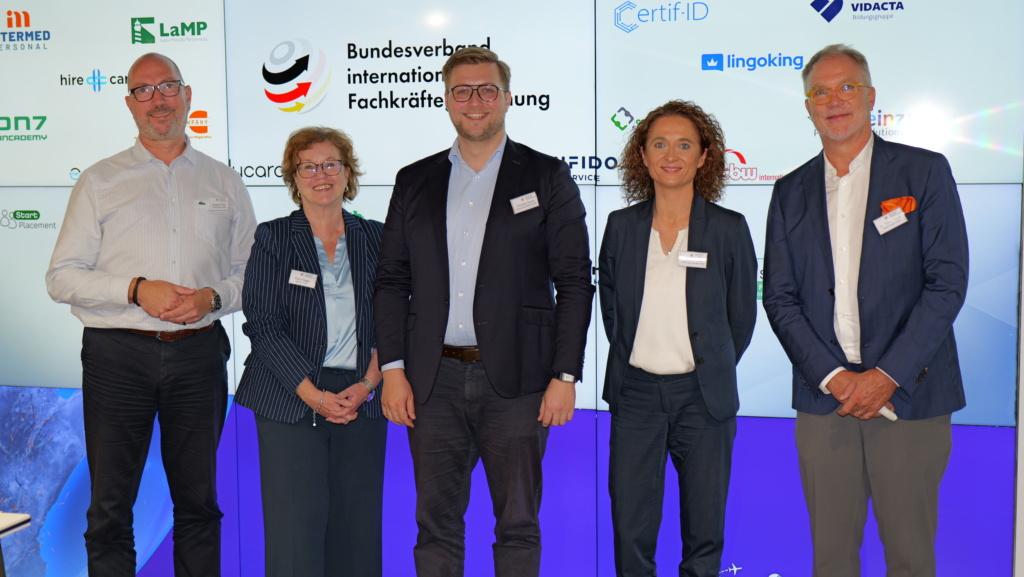
In the picture you can see the new executive board (from left): Secretary Andreas Finke, Second Deputy Chair Karin Nagel (Head of Business Division at Apontis GmbH), First Deputy Chair Christian Sassin (Managing Director of educaro GmbH), Treasurer Yvonne Bolach (Managing Director of Dekra Expert migration Gmbh), Chair of the Executive Board Tilman Frank (Managing Director of TalentOrange GmbH).
Unser Newsletter zum Thema internationale Fachkräftegewinnung.
Bleiben Sie up-to-date zu allen Themen rund um internationale Rekrutierung.