Early childhood educators from Latin America in Baden-Württemberg
Munderkingen, a municipality of 5,000 residents in the Alb-Donau district, southwest of Ulm, could be the very picture of idyll for young families: a picturesque old town with shingle-clad gabled houses, located directly on the banks of the Danube. Three daycare centres, a primary school and secondary schools, excellent rail connections, a committed mayor and a hands-on chief administrative officer. The perfect place for families—except: the daycare centres have too few Early Childhood Educators. None of the usual recruitment channels helped: advertising on Instagram, job postings on the municipality’s own website or in the local daily newspaper—everything unsuccessful. “We received only very few applications, or ones that were completely unsuitable,” reports Munderkingen’s mayor, Thomas Schelkle. “Germany is short of a total of 100,000 Early Childhood Educators. We feel that here, too.”
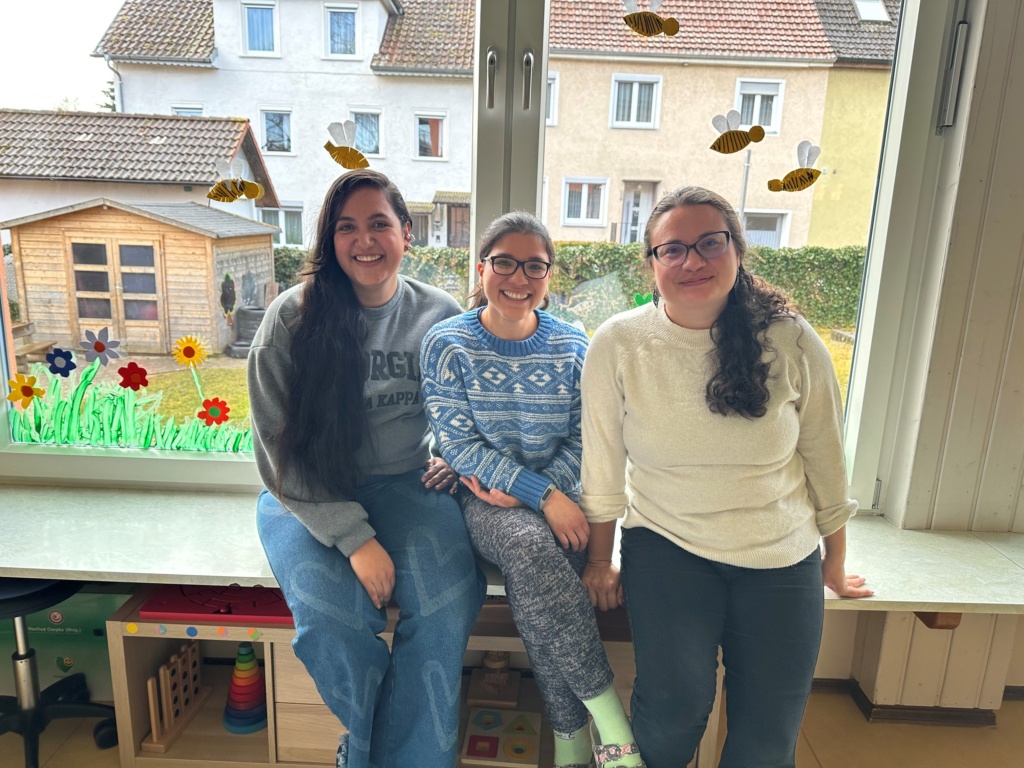
That is why the mayor and his chief administrative officer, Axel Leute, together with the municipal council, decided to take an innovative step: In October 2024, they commissioned TalentOrange to recruit three fully qualified Early Childhood Educators from Latin America. Since the beginning of February 2025, Lucia Gallo (36) and Yisell Romero (26) from Colombia, as well as Mildred Flor (31) from Ecuador, have been working as educational assistants at the Munderkingen Schillerstraße Children’s Centre. All three hold a completed Bachelor’s degree in early childhood education. For their qualification to be recognised in Germany, they only need to complete an Anerkennungsjahr. “After consultation with the Ministry of the Interior, they are allowed to shorten it with us to nine months,” says Thomas Schelkle. All three women obtained the German B2 language certificate through a nine-month full-time language course in their home country. They were already able to speak fluently when they started work and could understand the children and colleagues well.
In mid-October 2024, a video conference took place where all parties could get to know one another. Afterwards, the municipality of Munderkingen chose the three young women. A TalentOrange staff member travelled to Munderkingen to view the Early Childhood Educators’ workplaces and the apartment provided by the municipality. “It’s important that we also take care of the people who are new to Germany,” says Schelkle. And that is indeed the case: the small municipality is full of dedicated people who have welcomed the three young women warmly. The aim is for them, after completing the Anerkennungsjahr, to move seamlessly into permanent employment as Early Childhood Educators with the City of Munderkingen. Based on TalentOrange’s experience, 96 percent of international skilled professionals are still in Germany after 5 years, and 85 percent are still working in their first position after five years. “Of course we are hoping for a 100 percent rate,” says Axel Leute, “and we are making sure that the three Early Childhood Educators are doing well here.”
It’s working—the young women are happy to have found work in Munderkingen in the professions they trained for. In Colombia and Ecuador, it is not uncommon for a single vacant Early Childhood Educator position to receive 400 applications—the labour-market situation is the exact opposite. Yisell Romero also likes that children in Germany are able to play more self-directed than in her home country of Colombia. There, daycare is more like pre-school with a strict curriculum. Lucia Gallo says: “For me, it’s a dream to work in Germany and a great opportunity to develop further as an Early Childhood Educator.” Mildred Flor considers it important to get to know Germany and to apply her knowledge of Montessori pedagogy, which she learned in Ecuador.
The City of Munderkingen is convinced that the investment in international recruitment is worth it. The fee paid by the employer includes all costs for placement, the language course, the visas, all administrative matters, and the Early Childhood Educators’ relocation. “Basically, our only job is to give them a warm welcome,” says the chief administrative officer. The young women are paid in accordance with the collective agreement for the public sector. Mayor Schelkle and chief administrative officer Leute are convinced that if the city continued to look for Early Childhood Educators via the conventional route, it would spend just as much money—but without the guarantee of actually securing a qualified professional. “We owe it to families in Munderkingen to maintain our childcare provision,” says Schelkle. Now he has found a way to do so.
In this Video , Lucia Gallo, Yisell Romero and Mildred Flor introduce themselves and talk about their experiences as Early Childhood Educators in Munderkingen.
Video source: Schwäbische Zeitung. All rights reserved.