From Colombia to Wiesbaden: Early childhood educators in DRK daycare centers
A brand-new daycare center with 120 places—but not all of them could be filled. The reason was a shortage of staff. That was the situation at the German Red Cross (DRK) in Wiesbaden. It operates three daycare centers with a total of 60 Early Childhood Educators. However, there was a lack of qualified staff for the newly built daycare center in Nordenstadt on Hainweg, right in the middle of a new residential area full of young families. Parents were pressing—but there was nothing that could be done. Several places for children aged between 6 months and 6 years had to remain vacant.
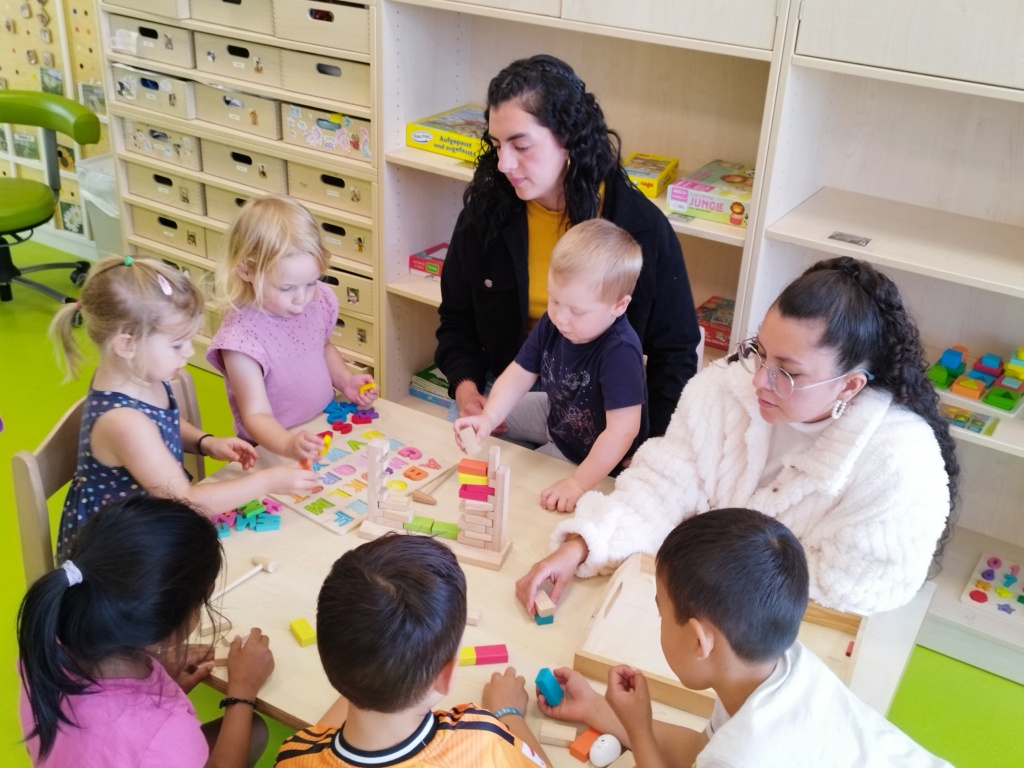
Until DRK decided to work with TalentOrange. In early December 2024, Monica Daza Laiton (23) and Angela Lisbeth Cortes Montero (27), two academically trained Early Childhood Educators from Colombia, began their Anerkennungsjahr at DRK—one at the Hainweg daycare center, the other at the Delkenheim daycare center. Two more Colombian colleagues followed in June 2025. After one year, they receive their certificates from the State of Hesse and are then fully recognized Early Childhood Educators. The remaining groups can now be set up step by step. The new colleagues are not yet solely responsible, but they take on positions of responsibility—and the children love them.
Yvonne Reichel, Head of the Daycare Centers department at DRK Wiesbaden, says: “The training of the Early Childhood Educators from Colombia is better than ours.” In their home country, they completed a Bachelor’s degree in early childhood education. “They already have practical experience and extensive knowledge; they approach their work very reflectively.” Angela has studied the Hessian Education and Childcare Plan in depth. Both Early Childhood Educators are impressed by how much freedom children in Germany have to decide what they want to do. “In Colombia, we know that freedom is important for children, but the system doesn’t allow a flexible daily structure,” says Monica Laiton. In Colombia, children are expected to learn letters and numbers as early as preschool age, ideally already doing arithmetic and reading. “I really like that children here choose their own challenges,” says Angela Montero. “We support them in doing so.” The families of the two young women support their step abroad—of course there is homesickness, and sometimes it is difficult to work pedagogically in a foreign language. The German winter was a challenge, as was the bureaucracy. “But we were helped, and here at work we have enough time to learn everything,” the two say.
Manfred Stein, Executive Board Member of DRK Wiesbaden, is very pleased to have finally found a good solution to the staff shortage—both on a human and an economic level. “If we have to leave places vacant, we don’t get them refinanced either. But we still have the costs for the large building.” He considers international recruitment to be a very good model. In the Early Childhood Educators’ countries of origin, the education system is underfunded, and there are not enough jobs for qualified educators. At the same time, a problem is being solved in Germany. “We’re all fishing in the same pond; daycare providers can now only poach Early Childhood Educators from one another. That’s why we’re happy about this innovative solution,” says Stein.
TalentOrange primarily finds well-trained Early Childhood Educators in Colombia and Namibia. Recruiters select them in their home countries based on strict professional and personal criteria, using interviews. They receive a free German course with a scholarship and are prepared for the B2 exam in German within 7 to 9 months. Language skills at this level are required in order to be allowed to work as an Early Childhood Educator in Germany.